Posts

Showing posts with the label i2c

NFC with a microbit

Image
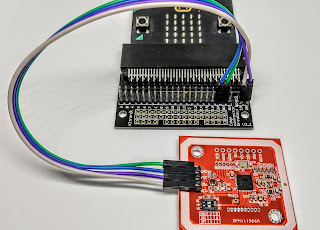
 Near Field Communication, or NFC, has been around for many years. It's a rather interesting technology, as it is very short range - just a few cm - and RFID tags don't need a power supply! The tags have a non-volatile memory - typically 1k bytes. These have uses ranging from pet "chipping" to tracking items in a factory or warehouse. We can get an NFC Reader at quite a low cost, around £6 at the time of writing. Most hobbyist articles on NFC use an Arduino or Raspberry Pi as the programmable controller for the project, but as the microbit is very popular, especially in schools, it seems worthwhile to show how it can be used. Hardware I used an NFC board (the NFC Module V3 from www.elechouse.com ) which is based on NXP's PN532 IC. It integrates all the required components, including the coil. The board is supplied with pretty much everything you need, including two RFID tags, so that you can try reading and writing to them. Here's the board connected to a mic...
Microbit WiFi weather station

Image
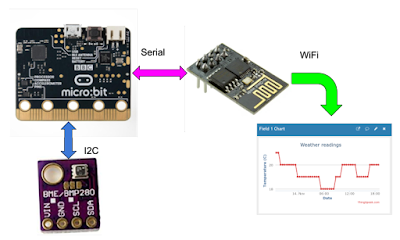
Introduction  This is a microbit project aimed at junior schools. It allows you to:  make regular readings of things you can measure electronically (such as  air pressure  and  temperature ) upload  those readings automatically via WiFi to a free  web service  ( ThingSpeak ) where you can store readings, and display the readings as a chart, for example It features: low current consumption (typically 2.2 mA average) easy set-up of your readings at ThingSpeak easy assembly of the parts  It evolved from some of my previous projects: a  Microbit weather station  for example, which used a pair of microbits to upload readings to a laptop or similar.  I've used a few good articles on the web to get this project running (see the Further reading section). The design is really quite simple and easy to use. No human intervention is required to upload the readings, and a Real Time Clock isn't needed as ThingSpeak records the date & t...

Microbit with an external ADC

Image
Update 4 Sept 2022: I found that the ADS1115 code below works fine when you are reading one channel. But when you are reading more than one channel (i.e. switching from one to the other) you can easily get a wrong reading. The reason behind this is described on a TI forum here . Briefly, you need to have a delay between setting the ADC channel and reading the conversion result. I have written an unpublished MakeCode extension which adds simple blocks and handles this delay. It can be used by pasting its Github location into the MakeCode Editor's "add extensions" search bar. Introduction This post shows how you can connect up a low-cost external ADC to a microbit using the I2C bus. The ADS1115 ADC has 4 channels and an on-chip voltage reference. Example code is provided for Micropython and MakeCode/JavaScript. Background The microbit includes an ADC, but it has limited usefulness for measuring voltages - particularly if you want to monitor the microbit's supply voltag...